In 2025, we spent about $15,000 putting Rock Property Group on digital billboards around Oklahoma City.
The idea seemed pretty simple.
You can ignore an email. You can scroll past an ad. You can throw away a postcard.
But if you’re sitting at a red light behind 30 cars, you’re probably going to see the giant sign directly in front of you.
We wanted that.
We were trying to make more people aware that we bought real estate and managed residential and commercial properties. We selected digital billboards at some of the busiest intersections in the market and even considered things like University of Oklahoma football games when large numbers of people would be on the road.
We designed a bunch of different ads. We tried to make them funny and memorable rather than looking like another generic real estate company.
One said:
“Is your rental annoying you? Let it annoy us instead.”
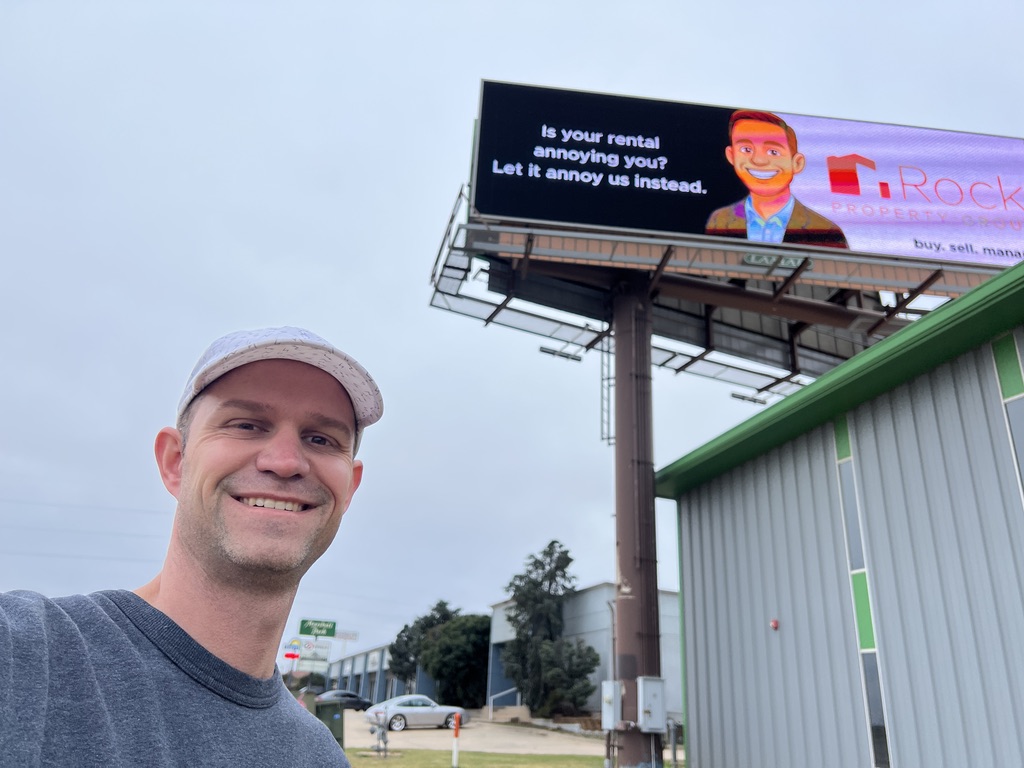
We used cartoon versions of ourselves and experimented with other slogans, including references to things that were trending at the time.
Then we put them all over town.
And waited for the phone to ring.
It didn’t.
People Definitely Saw Them
Digital billboards work differently from traditional static billboards.
The boards we purchased had multiple advertisers rotating through them. Our campaign moved among several high-traffic locations, generally spending a couple of weeks in one place before rotating somewhere else.
The billboard company could provide impressive estimates for traffic and impressions.
But I cared about a simpler question:
Did anyone call us?
Not that we could identify.
We didn’t see meaningful QR-code activity. We didn’t get someone calling and saying they wanted us to manage their rental because they had seen our billboard. We didn’t buy a property that we could clearly trace back to one.
That doesn’t prove the campaign produced absolutely nothing. Marketing attribution is imperfect, and someone could have seen a billboard and contacted us later without mentioning it.
For roughly $15,000, I expected to see business we could reasonably connect to the campaign.
We didn’t.
What did happen was interesting.
My phone started getting texts.
“I saw your billboard.”
People I already knew noticed them. My partners had the same experience. Friends, acquaintances and people within our existing network suddenly knew that Rock Property Group was advertising around Oklahoma City.
That actually has some value.
One of the most important things you can do when starting a real estate business is make sure people know what you do. Someone who already knows and trusts you may eventually have a rental property, know someone who wants to sell, or encounter somebody looking for a property manager.
The billboards reinforced that association.
The $15,000 was the cost of the campaign. I wanted to see enough business come from it to justify that expense.
Brand awareness has value. But the value still has to justify the expense.
That doesn’t mean the awareness was worthless, or that every result could be tracked. It means that, based on what we could observe, I don’t think we got enough value to justify what we spent.
We Were Trying to Say Too Much
Looking back, I think we approached billboards too much like advertisements.
A driver doesn’t have much time to figure out what you’re trying to tell them.
Our ads had a joke. They had a cartoon. They had our company name. They had information about what we did.
We also had a bunch of billboard templates, so the message changed from one board to the next instead of becoming more familiar through repetition.
None of it was particularly complicated while sitting at a desk looking at the design.
That’s not how anyone actually sees a billboard.
They’re driving.
The digital board may only appear briefly before another advertiser takes the screen. By the time someone notices it, reads it and starts figuring out what you’re selling, it’s gone.
I’ve since paid more attention to the billboards I actually remember.
They tend to fall into two categories.
The first is ridiculously simple and memorable.
I recently saw a law-firm billboard with a man’s photograph completely upside down. The message was essentially: In trouble? Call us.
You don’t have to study it. The absurdity gets your attention and the message takes a second to understand.
The other approach is almost the opposite: saturation.
There are businesses whose signs seem to be everywhere. The individual billboard isn’t particularly clever. It may essentially be a name, logo and one idea.
But you see it again.
And again.
And again.
Eventually you know exactly who that company is.
I think we landed awkwardly between those two strategies.
We weren’t ridiculous enough to make one brief impression unforgettable, and we weren’t buying enough of the market to make our name unavoidable through repetition.
Would I Do It Again?
Probably not.
That’s not because I think billboards don’t work. I’m also not a marketing expert trying to tell other businesses how they should advertise.
I’m a customer who spent enough money on them for the experiment to matter.
And I learned something.
If I were going to use billboards again, I would make the mission extremely narrow and keep the message consistent across the campaign.
One message. Lots of billboards.
Four or five words may be better than fifteen. Giant text. A visual that’s almost impossible not to notice. And one thing I want the person seeing it to remember.
If saturation were the strategy, I’d commit enough money and enough placements to make that same message familiar through repetition.
That requires more discipline than we had during our experiment.
We wanted our billboards to explain who we were, what we did and why someone should remember us.
That’s too much work for a sign someone passes at 45 miles per hour.
Our campaign wasn’t a complete failure. People saw us. People remembered us. People who already knew me began associating me more strongly with real estate and property management.
That’s useful.
I just don’t think it justified the roughly $15,000 we spent.
Sometimes the lesson from a marketing experiment isn’t that the medium doesn’t work.
It’s that you finally understand what the medium is actually good at—and whether that value is worth the cost to your business.